1. Industry reconfiguration

Your growth plan just got
interesting

AI, climate change and shifting geopolitics are changing the way we live and work.

Creating new customer needs and preferences. Forging new markets. Enabling new business models. Attracting new competitors. And blurring the boundaries of sectors and industries.

It’s time to look for growth in new places.

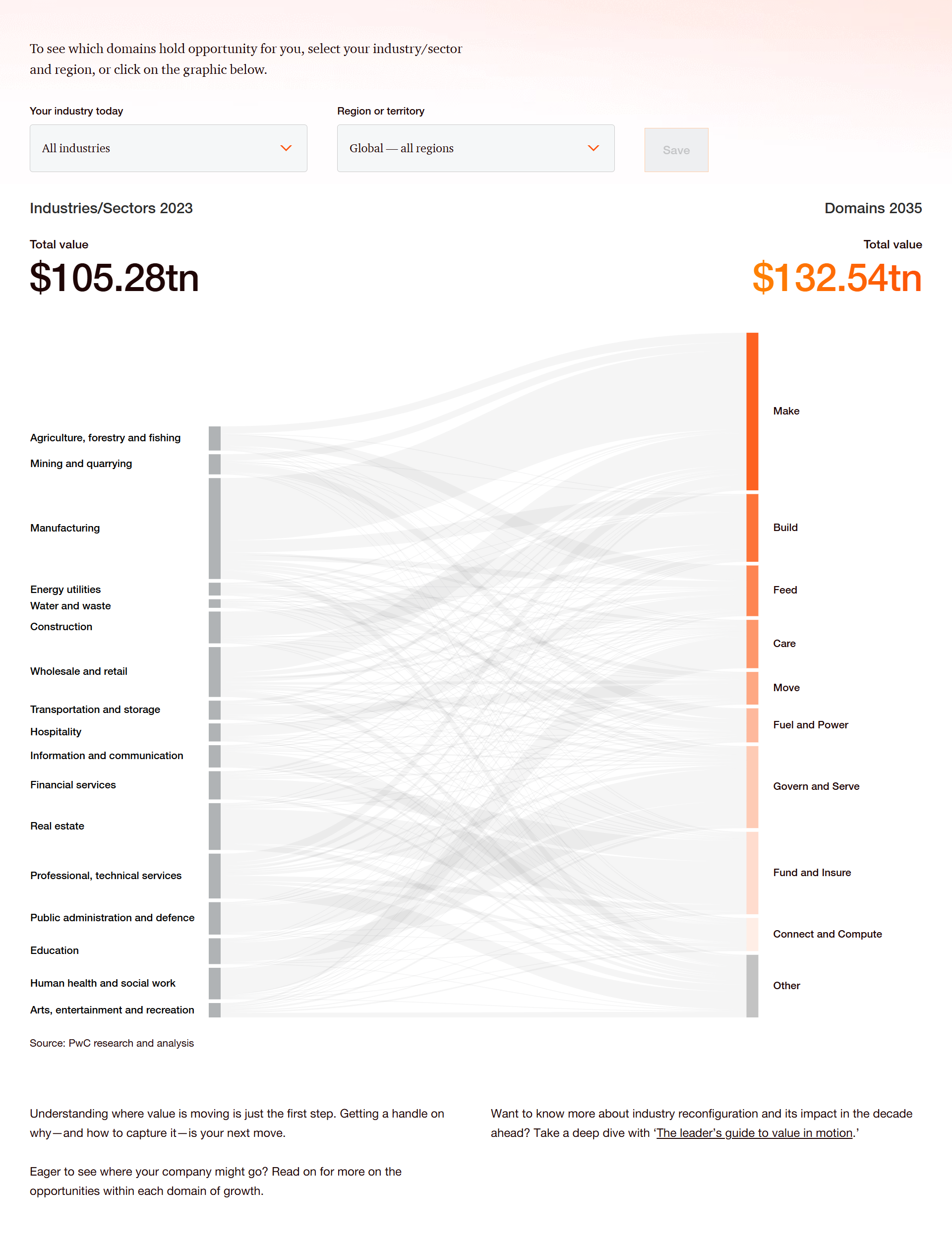
It’s time to explore new domains of growth markets where companies work across sector boundaries to meet fundamental human needs. Like how we feed and care for ourselves, move, make and build things, and how we fuel and power it all.

Scroll on to understand how these domains will form and grow. And discover how to seize your share of the value in motion.

See the shifts

2. Domains of growth

Explore your new domains

Select from the nine domains below to learn how they are forming, the size of the opportunity and how to seize the value in motion.

How we make

To meet the world’s need for materials and industrial goods, manufacturing must reinvent itself through innovation, digitisation and automation.

An epochal transformation of manufacturing is underway.

In the Fourth Industrial Revolution, manufacturers are a beacon of innovation embracing the use of new technologies such as automation, 3D printing and AI to boost their productivity, efficiency and agility. Companies are already using these advances to reinvent themselves. As a result of these efforts, up to US$1.8 trillion of manufacturing revenues could be redistributed in 2025.

Other powerful catalysts include the need to insulate supply chains from climate shocks, the push to improve sustainability and circularity, the growing demand for workers with specialised skills, and the impact of geopolitical tensions on trade routes. Together, they’re combining to forge a major sectoral reconfiguration in manufacturing.

An expansive ecosystem is forming as companies reimagine what and how we make.

The Make domain will be a more diverse, tech-enabled zone in which firms integrate their capabilities and knowledge to create offerings that better meet customers’ increasingly complex needs. The new cast of players: classic manufacturers, along with IOT providers, AI firms, cybersecurity specialists and robotics companies.

Cross-sector collaboration has already helped companies develop elegant, multifaceted solutions. Aerospace companies boost aircraft and engine uptime by combining remote monitoring, predictive analytics, coordinated inventory management and automated maintenance scheduling. In other instances, customers pay for a function like energy generation, heating or filtration, while the company owns and manages the equipment, enhancing efficiency with the IOT and advanced analytics.

The burgeoning Make domain offers significant economic gains to decisive players.

Companies will find growth opportunities by looking across traditional sectors and recognising distinct areas of customer need, such as raw materials, manufacturing data, climate solutions and materials science. By 2035, the Make domain could contribute $34.17 trillion to global GDP, representing about a quarter of total output.

The extent of that growth will depend on how megatrends play out.

To obtain a quantitative picture of what the Make domain might look like in 2035, we modelled the potential global economic impact of two of the most pressing megatrends: technological disruption (specifically disruption from AI) and climate change. The result is three divergent scenarios, corresponding to a range of outcomes, from a low of $33.91 trillion to a high of $36.84 trillion.

3. The opportunity

Capturing the value in the decade ahead

Businesses that grasp the full potential of the Make domain will have the edge in 2035.

Sizing the Make opportunity

The nature and scale of the new business opportunities that emerge in the Make domain will depend on how AI adoption and climate action progress. Your strategy should account for a range of possible outcomes.

Three scenarios can help leaders in the Make domain consider what the future might bring.

In Trust Based Transformation, a coordinated, conscientious approach to tech deployment and climate response fosters productivity growth, job creation and environmental health.

In Tense Transition, regionalisation and nationalism give rise to technology systems and sustainability efforts that deliver benefits without the economies of global scale.

In Turbulent Times, atomised interests, divisive uses of technology, and suspended sustainability initiatives hamper economic growth.

Learn more about the three divergent tomorrows.

Seizing the Make opportunity

In a future of divergent possibilities, imagining new ways to create value can help reframe how we think about viable business models, products and services.

Regardless of the scenario, leaders can act now to ensure they succeed in the decade ahead.

Show me actions I can take today

Imagining your 2035 business model

Fast forward a decade. What sorts of innovative offerings might generate outsize value for companies in the Make domain? To help leaders expand their thinking, we’ve imagined hypothetical businesses in the context of the three scenarios.

Full scope energy innovation partner
Digitised recruiting and hiring platform
AI optimised materials management company
Construction Illustration

Full scope energy innovation partner

Trust Based Transformation

International renewable energy standards, cross border energy and carbon trading, and widespread trust in sharing data create an opening for a provider of turnkey clean energy services to global manufacturers. Instead of charging for energy by the unit, the company collects payment for delivering precisely enough power to keep customers’ facilities running in a cost effective way giving all parties an incentive to maximise efficiency. The approach begins with analysing each manufacturer’s energy needs and cutting demand through equipment tweaks or upgrades. Next, the service provider builds onsite facilities for renewable electricity generation and storage, and configures the system to source or provide carbon free grid power as market prices fluctuate. Additional revenues come from carbon credits earned as the system runs.

Who’s got the edge?

  • Renewable equipment makers that can extend down the value chain by installing custom solar arrays, batteries and energy management systems for individual properties
  • Providers of smart city infrastructure that can use their network data to aggregate energy supply and demand, and optimise generation and storage across urban districts
  • Telecom companies with distributed infrastructure assets that can connect power providers with users and collect and analyse data

Future growth area

Developing solutions to electrify and decarbonise hard to abate sectors like concrete and steel.

Construction Illustration

Digitised recruiting and hiring platform

Tense Transition

The market for computer-literate assembly-line workers is volatile. Sometimes, companies need large pools of employees. At other times, workers are willing to accept flexible arrangements, such as short-term contracts. Responding to these complexities, a tech company sets up a digital hiring platform that rapidly connects workers with jobs. It uses AI to analyse the skills, locations and other attributes indicated in job postings and worker profiles, and suggest matches collecting fees when matches are made and as workers remain on the job past discrete benchmarks. Powerful analytics deliver real time updates and forecasts of manufacturing activity to help employers adapt as conditions change.

Who’s got the edge?

  • Online learning platforms that can match users with suitable jobs, with intuitive features for both employers and workers
  • Providers of remote-working solutions that can capitalise on their knowledge of employee behaviours and preferences to optimise the screening, evaluation and matching of candidates
  • Financial institutions that use payment data to predict worker availability and connect companies with prospective employees before they start searching for jobs

Future growth area

Implementing blockchain technology to enable secure and transparent contract management, quality control reporting, and payments.

Construction Illustration

AI optimised materials management company

Turbulent Times

In a world of resource nationalism, a technology enabled business has the opportunity and incentive to develop closed loop capabilities for sourcing and supplying materials. With prices for copper and steel at a premium, the company uses equipment powered by AI and machine learning to automate and optimise waste sorting and processing. Predictive systems loaded with point of sale data from retailers identify consumers who might be convinced to turn in their older home appliances. The company is able to make dynamically priced offers in times of high demand. Through innovative leasing contracts, the company provides standardised materials as a service to producers of industrial equipment and reclaims the materials after equipment is retired from service, thereby retaining value and eliminating waste.

Who’s got the edge?

  • Logistics and delivery companies that can operate scalable recycling infrastructure
  • E commerce platforms that incorporate customer-relationship management analytics and AI to track sales and encourage end-of-life use of products
  • Manufacturing companies that can partner with local governments and businesses to create incentives for the recovery and reuse of industrial waste

Future growth area

Launching a subscription-based and ad-supported consumer app that gamifies recycling.

Select a bar below to see projected values and how each scenario might influence the Make domain.

Trust Based Transformation

$36.84tn

Tense Transition

$35.36tn

Turbulent Times

$33.91tn

Trust Based Transformation

Global alignment Responsible tech Sustainable solutions

Demand for goods and equipment that cause minimal harm to the environment along with strict environmental regulations encourages businesses to embrace sustainable sourcing and production practices. Waste reduction and resource circularity become governing concepts for successful manufacturing firms. Technology firms develop AI and data-security tools to promote transparency and efficiency along value chains.

Six more future-ready business ideas

These quick-hit concepts some of them suited for just one future scenario, others for more offer additional inspiration for business model innovation.

Trust Based Transformation
Tense Transition
Turbulent Times
Closed-loop materials formulated for maximum recoverability and reuse
Cybersecurity for IoT devices and software
Seamless aggregation and sharing of manufacturing data
Least-cost, lightweight materials derived from waste
Manager of regional manufacturing networks that streamline distribution and withstand disruption
AI driven, robot-equipped warehousing systems

To reinvent for multiple tomorrows, take action today

The process of reinvention needs to start now, with a focus on priorities that respond to the reconfiguration that’s already underway. This means driving hard towards a set of innovation imperatives, securing competitive advantages in areas such as technology and trust, and turning obstacles such as climate threats into enablers of growth.

Get in touch with Ryan
Innovation imperatives
Sources of competitive advantage
Turning obstacles into enablers

Today’s manufacturing sector is making impressive advances in automation and digitisation. Many players in the Make domain are already well-equipped to initiate the critical changes to their operating and business models that will help their organisation withstand and leverage sudden market shifts, unstable supply chains and resource scarcity. Here are a few key areas of innovation to target.

Artificial intelligence

AI enabled flexible manufacturing systems, supported by robotics and automation, can drive mass personalisation and customisation.

Supply chain

real time tracking, adaptive logistics, and micromobility solutions can yield efficiency and streamline last-mile delivery.

Energy use

Electric trucks, green roofs, solar panels, optimised insulation, and natural lighting can deliver significant savings.

Advanced digitisation and next-gen production

Digital-twin tech, predictive analytics, and on-demand 3D printing can accelerate R&D and reduce supply chain dependency.

Technology is a critical differentiator in the Make domain, and getting an edge doesn’t just mean replacing legacy IT and upgrading data capabilities. Meaningful advantage comes from applications of leading-edge tools originating in other sectors. Another distinguishing factor: trust, both within and outside the organisation.

Technological innovations

Among the tools that are already driving massive change: wearable devices, precision robotics and remote monitoring tools, first developed for the pharma and life sciences industries. Similarly, pressures in the semiconductor industry have produced advances in extreme ultraviolet lithography, which enables miniaturisation of circuits, and in next-gen materials like graphene.

The advantage of trust

ECompanies are boosting customer engagement via new digital platforms that let them learn more about their customers and enable personalisation. Inside the organisation, manufacturers are creating robust feedback mechanisms to give workers an active role in product development and to improve communication between management and the factory floor.

Reducing exposure to physical climate risk is an urgent challenge, as is emissions mitigation, especially for hard-to-decarbonise subsectors. Both these urgencies also represent opportunities for companies that can innovate fast enough. Here are some areas where players in the Make domain can start taking action now.

Materials innovation

Supply chain emissions and extreme weather events are giving manufacturers reason to rethink the selection and sourcing of materials. More climate-friendly materials are being developed through advances in materials science (especially those breakthroughs enabled by biotechnology and nanotechnology) and in process engineering. Closed-loop designs and recovery systems can reduce environmental impact and preserve value by keeping materials in use for longer. Such advances can also help Make companies less dependent on far-flung production sites.

Operational transparency

Recently adopted regulations in Europe and other large markets mean that companies must demonstrate responsibility for the environmental and social impacts that occur in their operations and supply chains by measuring and reporting to a greater extent than before. In meeting these compliance requirements, companies will collect data that can reveal opportunities to lower costs or otherwise improve performance.

How we build

Our need for places to live and work is growing and changing. To meet it, industries are converging on innovative ways to build.

Constructing the future means reimagining the way we build..

Until recently, the companies building the structures and cities where we live, work, meet and play have competed in discrete sectors: engineering, construction, manufacturing, finance and real estate.

But global megatrends are rapidly changing what people need from the built environment, and how those needs can be met. Climate change is intensifying demand for resilient, efficient homes, factories and airports. Urbanisation is putting more pressure on housing and infrastructure. AI promises to lift architects’ and builders’ productivity.

Firms are responding with efforts to build more, and to do so faster and better than ever through alliances, partnerships and new ventures. This industry reconfiguration is giving rise to a domain of economic growth centred on how we build.

Firms can create value by working across sector boundaries.

Some real estate developers are using their strong balance sheets and financial savvy to establish venture capital funds that invest in sectors like property tech and energy efficiency.

Technology firms are competing with home appliance manufacturers by deploying smart devices and software that control home heating, cooling and lighting.

And some engineering companies are using their accumulated expertise and global relationships to expand into the management of wastewater systems, the detection of forever chemicals, and the development of renewable energy plants.

In the construction sector alone, up to US$517 billion of revenues could be redistributed in 2025 as firms reinvent their business models.

The value of the Build domain is projected to reach $13.76 trillion by 2035.

Much of that growth will come from the swift expansion of some nascent sources of value, such as prefabrication and modular construction, energy management and building-materials recycling.

The interplay of powerful factors will shape the trajectory of growth.

To help business leaders understand the possibilities for the coming decade, we modelled the domain’s growth under three divergent scenarios accounting for the impact of technological progress (specifically from AI) and climate action. Depending on the scenario, the domain’s size in 2035 could be as much as 3.0% above the baseline contribution of $13.76 trillion to global GDP or as little as 1.8% below it.

3. The opportunity

Capturing the value in the decade ahead

Businesses that grasp the full potential of the Build domain will have the edge in 2035.

Sizing the Build opportunity

The nature and scale of the new business opportunities that emerge in the Build domain will depend on how AI adoption and climate action progress. Your strategy should account for a range of possible outcomes.

Three scenarios can help leaders in the Build domain consider what the future might bring.

In Trustb Based Transformation, a coordinated, conscientious approach to tech deployment and climate response fosters productivity growth, job creation and environmental health.

In Tense Transition, regionalisation and nationalism give rise to technology systems and sustainability efforts that deliver benefits without the economies of global scale.

In Turbulent Times, atomised interests, divisive uses of technology, and suspended sustainability initiatives hamper economic growth.

Learn more about the three divergent tomorrows.

Select a bar below to see projected values and how each scenario might influence the Build domain.

Trust Based Transformation

$14.17tn

Tense Transition

$13.80tn

Turbulent Times

$13.51tn

Seizing the Build opportunity

In a future of divergent possibilities, imagining new ways to create value can help reframe how we think about viable business models, products and services.

Regardless of the scenario, leaders can act now to ensure they succeed in the decade ahead.

SImagining your 2035 business model

Fast forward a decade. What sorts of innovative offerings might generate outsize value for companies in the Build domain? To help leaders expand their thinking, we’ve imagined hypothetical businesses in the context of the three scenarios.

50-50 construction and development firm
Ecosystem management platform
Embedded insurance for industrial construction
Construction Illustration

50-50 construction and development firm

Trust Based Transformation

This business tackles the intractable challenge of low-income housing by partnering with engineering, technology and manufacturing companies to design and deliver residential properties that are affordable, modular, safe and sustainable. It relies heavily on housing data and engagement with housing advocates and regulators. The company assembles homes at a prefab facility where many components are 3D printed. Building materials including carbon-free concrete, solar roofing panels and sustainably grown bamboo are chosen for their energy efficiency and reuse potential.

Who’s got the edge?

  • Tech companies that can bring deep experience in AI, smart-city technologies, robotics, smart grids, or urban farming solutions
  • Logistics firms that can partner with manufacturers of modular construction to efficiently deliver structures and materials to worksites
  • Companies developing smart materials, such as self-healing concrete, adaptive cladding and energy-efficient insulation

Future growth area

Rehab, renovation and reclamation activities that can repurpose water, power and air-quality infrastructure, and profitably process recyclable materials such as wood, steel and insulation.

Construction Illustration

Ecosystem management platform

Tense Transition

This AI-enabled software platform facilitates alliances among the construction, manufacturing, technology and energy companies involved in major capital projects for the residential, commercial and infrastructure realms. Informed by experience organising and managing ecosystems, the cloud-based application lets companies connect with prospective partners about new project opportunities, solicit and evaluate bids, and formalise roles and contractual responsibilities in a streamlined, rigorously documented way. Users lower their costs, develop reliable order backlogs and strengthen their supply chains. The platform’s AI simulations let users model the effects of ongoing regulatory changes, shifting budgets and accelerating climate forecasts on their projects.

Who’s got the edge?

  • Construction firms looking for discrete, tactical ways to leverage their capabilities
  • Project management companies that capitalise on their knowledge of real time analytics, predictive modelling and automation of project workflows
  • Utility companies familiar with managing large networks of vendors and subcontractors in a highly regulated environment

Future growth area

Cross-industry alliances, with fewer silos than in today’s environment, that will enable regionally competitive offers which pave the way for delivery models that are modular, faster, cheaper and higher quality.

Construction Illustration

Embedded insurance for industrial construction

Turbulent Times

Construction of factories, power plants, refineries and warehouses carries unique risks, requiring specialised equipment, materials, and in depth knowledge of regulatory and environmental requirements. A new type of construction firm embeds insurance products into its projects, covering losses during design and construction (due to fire, theft or natural disaster) and over the lifespan of the building. It offers the client protection against risks pertaining to the quality of the facility, safety audits and regulatory compliance. Partnering with a reputable insurance provider establishes credibility and mitigates risk. For clients, obtaining insurance as an embedded product simplifies the process and enhances their trust in the project.

Who’s got the edge?

  • Construction firms with advanced expertise deploying IOT devices in safety and compliance audits
  • Financial services firms with an insurance background in industrial construction and proficiency in embedded finance
  • Technology companies that can integrate real time data on project risks into models that simplify the management of policies and claims

Future growth area

Embedded finance functions across a single platform, including payments, lending and credit, insurance, and banking.

Six more future-ready business ideas

These quick-hit concepts some of them suited for just one future scenario, others for more offer additional inspiration for business model innovation.

Trust Based Transformation
Tense Transition
Turbulent Times
Cloud-based, AI-enabled time and project management software for architects
Specialised insurance products to cover risks from social instability and cyberattacks
real time data gathering and analysis from connected buildings
Provider of modular construction products
Energy-saving building control for office towers and public buildings
Construction 4.0 consulting firm

To reinvent for multiple tomorrows, take action today

The process of reinvention needs to start now, with a focus on priorities that respond to the reconfiguration that’s already underway. This means driving hard towards a set of innovation imperatives, securing competitive advantages in areas such as technology and trust, and turning obstacles such as climate threats into enablers of growth.

Innovation imperatives
Sources of competitive advantage
Turning obstacles into enablers

Today’s manufacturing sector is making impressive advances in automation and digitisation. Many players in the Make domain are already well equipped to initiate the critical changes to their operating and business models that will help their organisation withstand and leverage sudden market shifts, unstable supply chains and resource scarcity. Here are a few key areas of innovation to target.

Artificial intelligence

The applications of this fast-evolving set of technologies have huge transformative potential for the Make domain. AI enabled flexible manufacturing systems, supported by advanced robotics and automation, can drive mass personalisation and customisation. AI can also be used to optimise workflows for maximum efficiency and to manage plant maintenance.

Supply chain

Investing in real time supply chain tracking and enhanced traceability, and in smart adaptive logistics, can yield substantial cost savings and efficiency gains, freeing resources for reinvention moves. Micromobility solutions can help streamline last-mile delivery.

Energy use

Electric trucks, green roofs, solar panels, optimised building insulation, natural lighting these are relatively straightforward investments that can also deliver significant savings.

Advanced digitisation and next-gen production

Digital-twin technology and predictive analytics can radically accelerate R&D efforts a potential advantage when piloting a new business concept. And on-demand 3D printing of complex parts can reduce third-party dependency and insulate against supply chain disruptions.

Technology is a critical differentiator in the Make domain, and getting an edge doesn’t just mean replacing legacy IT and upgrading data capabilities. Meaningful advantage comes from applications of leading-edge tools originating in other sectors. Another distinguishing factor: trust, both within and outside the organisation.

Technological innovations

Among the tools that are already driving massive change: wearable devices, precision robotics and remote monitoring tools, first developed for the pharma and life sciences industries. Similarly, pressures in the semiconductor industry have produced advances in extreme ultraviolet lithography, which enables miniaturisation of circuits, and in next-gen materials like graphene.

The advantage of trust

Companies are boosting customer engagement via new digital platforms that let them learn more about their customers and enable personalisation. Inside the organisation, manufacturers are creating robust feedback mechanisms to give workers an active role in product development and to improve communication between management and the factory floor.

Reducing exposure to physical climate risk is an urgent challenge, as is emissions mitigation, especially for hard-to-decarbonise subsectors. Both these urgencies also represent opportunities for companies that can innovate fast enough. Here are some areas where players in the Make domain can start taking action now.

Materials innovation

Supply chain emissions and extreme weather events are giving manufacturers reason to rethink the selection and sourcing of materials. More climate-friendly materials are being developed through advances in materials science (especially those breakthroughs enabled by biotechnology and nanotechnology) and in process engineering. Closed-loop designs and recovery systems can reduce environmental impact and preserve value by keeping materials in use for longer. Such advances can also help Make companies less dependent on far-flung production sites.

Operational transparency

Recently adopted regulations in Europe and other large markets mean that companies must demonstrate responsibility for the environmental and social impacts that occur in their operations and supply chains by measuring and reporting to a greater extent than before. In meeting these compliance requirements, companies will collect data that can reveal opportunities to lower costs or otherwise improve performance.

How we feed ourselves

The agri-food system is at a pivot point. Feeding 10 billion people at mid-century will require a cross-sector push for innovation in the decade ahead.

The food system must be reconfigured to deliver abundance, resilience and sustainability.

Today’s food system is a complex global network: farmers produce, traders distribute, manufacturers process, retailers sell, and the public sector supports and regulates to make food available daily. It’s also a system under pressure. Climate perils such as drought and heat stress threaten crops. The scarcity of water, arable land and other key resources is mounting. Food waste and loss eliminate one-third of what is produced for people to eat. All of these will be critical challenges as the global population nears 10 billion in 2050.

Some shifts towards a system that better supports well-being and growth are already underway: companies are ramping up efforts to reinvent their business models. In the accommodation and food services sector, we expect such efforts will cause US$188 billion of revenue to move among companies in 2025.

Innovative, cross-sector relationships will redefine how we feed ourselves.

The answers to many of the challenges facing our food system will come from cooperative innovation. We must simultaneously scale technology, mechanisation and sustainability in farming; reduce waste and make processing more efficient; and adapt to healthier, eco-conscious diets. Above all, we’ll need to mitigate the impacts of climate and weather volatility on the food supply.

As companies redesign the way food is produced, processed and consumed, they will form partnerships that span existing sectors: farmers and agricultural firms, wholesalers and transport organisations, equipment makers and tech players, processors and retailers, research labs, and financial institutions. The resulting mix of activities will make up a unified, growing domain centred on how we feed ourselves.

The expanding Feed domain will create opportunities for resourceful businesses to grow.

Amid the transition, exciting prospects are emerging around farming, food processing, urban agriculture, data and logistics. Innovations such as AI driven crop monitoring and precision farming could revolutionise how food is grown, and initiatives aimed at cutting food waste estimated to cost the global economy $1 trillion annually open new avenues for improving efficiency and environmental impact.

We project that in ten years, the evolving Feed domain could contribute $9.88 trillion to global GDP.

Leaders must prepare for a broad range of possible conditions.

Which areas of the Feed domain generate the most value will depend in part on how global megatrends unfold. To explore the possibilities, we modelled the potential economic impact of two of the most pressing megatrends: technological disruption (specifically from AI) and climate action. This analysis, performed under three discrete scenarios, points to a range of potential sizes for the Feed domain.

The lowest projected GDP contribution, $9.85 trillion, is only slightly off the baseline, while the highest reaches $10.83 trillion.

3. The opportunity

Capturing the value in the decade ahead

Businesses that grasp the full potential of the Feed domain will have the edge in 2035.

Sizing the Feed opportunity

The nature and scale of the new business opportunities that emerge in the Feed domain will depend on how AI adoption and climate action progress. Your strategy should account for a range of possible outcomes.

Three scenarios can help leaders in the Feed domain consider what the future might bring.

In Trust Based Transformation, a coordinated, conscientious approach to tech deployment and climate response fosters productivity growth, job creation and environmental health.

In Tense Transition, regionalisation and nationalism give rise to technology systems and sustainability efforts that deliver benefits without the economies of global scale.

In Turbulent Times, atomised interests, divisive uses of technology, and suspended sustainability initiatives hamper economic growth.

Learn more about the three divergent tomorrows.
Select a bar below to see projected values and how each scenario might influence the Feed domain.

Trust Based Transformation

$10.83tn

Tense Transition

$10.34tn

Turbulent Times

$9.85tn

Seizing the Feed opportunity

In a future of divergent possibilities, imagining new ways to create value can help reframe how we think about viable business models, products and services.

Regardless of the scenario, leaders can act now to ensure they succeed in the decade ahead.

Imagining your 2035 business model

Fast forward a decade. What sorts of innovative offerings might generate outsize value for companies in the Feed domain? To help leaders expand their thinking, we’ve imagined hypothetical businesses in the context of the three scenarios.

AI engine for sustainable agriculture
Distributed urban agriculture-as-a-service
Fuel for humans
Construction Illustration

AI engine for sustainable agriculture

Trust Based Transformation

Encouraged by government incentives for environmental conservation and guided by responsible AI regulations, a software company creates solutions that help farmers use resources and land more efficiently. Farmers’ yields improve as they act on suggestions about which crops to plant, and when, from predictive analytics that combine weather projections with the aggregated, anonymised buying plans of food companies. Algorithms take data from on-field sensors and generate farm-specific tips for applying precision nutrients and bio-pesticides. AI systems direct robots in harvesting delicate produce such as strawberries at the optimal moment, maintaining freshness and reducing spoilage. AI, computer-vision sensors and robotic systems bring greater precision to crop sorting so that more food is properly graded for sale to traders and CPG companies and less is discarded.

Who’s got the edge?

  • Industrial tech firms with expertise in analytics and automation that can transfer from factories to fields
  • Farm equipment makers that can augment existing products with IoT and AI features and develop offerings such as self-driving tractors
  • Start-ups developing innovative farming technologies, such as drones and precision sensors

Future growth area

Advanced monitoring to support alternative farm revenue streams such as agrivoltaics (the dual use of land for solar energy and agriculture).

Construction Illustration

Distributed urban agriculture-as-a-service

Tense Transition

For cities where fresh food is scarce or prohibitively expensive, entrepreneurs develop a compact growing system. The self-contained unit can be rapidly assembled and adapted to grow a variety of food including tubers, legumes, mushrooms and algae on rooftops, in vacant lots, and even underground. Supportive local zoning policies encourage building owners to incorporate the growing systems into their properties and then either supply produce to tenants or collect it for local distribution. Efficiency and productivity are enhanced through circular practices (such as routing grey water and organic waste into the system and composting agricultural waste onsite), and the value of the crops is sustained through canning and long-term storage.

Who’s got the edge?

  • Utilities with experience building and operating small-scale renewable energy systems, storage facilities and reuse programmes (e.g., using heat from data centres to support greenhouses)
  • Heating, ventilation and cooling equipment manufacturers that can engineer and integrate building systems
  • Urban landscaping and horticulture firms with knowledge of how to cultivate plants in non-traditional spaces (like indoors or on rooftops)
  • Grocery retailers with existing urban real estate (like rooftops)

Future growth area

Educational programmes in sustainable food production.

Construction Illustration

Fuel for humans

Turbulent Times

Drawing upon expertise in the healthcare and consumer goods industries, a company engineers and mass-produces edible substances that meet people’s nutritional needs in an environmentally benign, cost-effective way. Low-income consumers benefit from eating inexpensive formulations sourced from labs, insects and commodity crops. Affluent customers turn to premium product variations, designed to optimise wellness and performance, to round out their diets. The company combines biotech savvy and production capabilities to achieve efficiency, and it prioritises supply chain resilience to withstand market fluctuations.

Who’s got the edge?

  • Pharmaceutical and dietary-supplement companies with experience marketing health products
  • Food-processing companies that have mastered large-scale production, including regulatory compliance requirements
  • Biotech firms capable of manipulating natural and artificial ingredients to achieve specific health effects

Future growth area

Personalised nutrition

Six more future-ready business ideas

These quick-hit concepts some of them suited for just one future scenario, others for more offer additional inspiration for business model innovation.

Trust Based Transformation
Tense Transition
Turbulent Times
Localised food communities
Automation and robotics for meal preparation and cooking
Food and agriculture data analytics platforms
Alternative approaches to food preservation
Food redistribution systems
Food safety and traceability

To reinvent for multiple tomorrows, take action today

The process of reinvention needs to start now, with a focus on priorities that respond to the reconfiguration that’s already underway. This means driving hard towards a set of innovation imperatives, securing competitive advantages in areas such as technology and trust, and turning obstacles such as climate threats into enablers of growth.

Innovation imperatives
Sources of competitive advantage
Turning obstacles into enablers

Take an ecosystem perspective

Knowing the important players within the food ecosystem, and the roles they play, will let firms capitalise on opportunities and address key pain points.

Collaborate with diverse stakeholders to spark innovation

No single entity can keep up with the accelerating pace of change. Invest in R&D through in-house teams and relationships with start-ups to harness the emerging trends that are transforming production, value chains and consumption. Innovation in ingredients, as in pharmaceutical research, demands significant investment and strict safety standards. The same is true in farming: be patient, test thoroughly, and integrate evolving technology.

Invest in growth markets to stay agile

In emerging regions, focus on affordable nutrition: lower relative incomes may be balanced by high-volume growth. In mature markets, begin the shift from making products to providing services that will let you capture more value.

Build transparency and agility into your business

As market dynamics shift, capabilities in technology, data and analytics will be key differentiators.

Harness technology for consumer insights

Deepen your understanding of consumer behaviour by incorporating cutting-edge technology and data analytics. Extract insights that emphasise hyper-personalisation, convenience and nutrition. Collaborate with retailers and e commerce platforms to anticipate future consumer trends. Stay relevant with a market-focused approach that’s sensitive to the diversity of local preferences.

Implement continuous scenario-planning

Map out the key players, evolving dynamics and potential vulnerabilities in the Feed domain as it takes shape. Come to grips with regional disparities and how they will affect your business. Talk to your R&D organisation, which often can anticipate new trends better than others. Strategic foresight will help build resilience into your supply chains as you plan for an increasingly complex landscape.

Enhance your climate resilience

Agri-food businesses must develop strategies that address today’s challenges and tomorrow’s uncertainties.

Compete for scarce resources by prioritising climate resilience

Diversify sourcing, and start assembling a flexible portfolio of inputs (including the partial replacement of at-risk ingredients). Adapt to climate volatility by planning for the potential relocation of factories, regionalising supply chains and investing in underutilised agricultural areas. Use technologies like blockchain to boost transparency, traceability and risk mitigation across your supply chains.

Reconsider your manufacturing processes

As the changing climate threatens the viability of traditional inputs, businesses must be ready to adapt investing in new manufacturing technologies and optimising existing ones. One avenue for optimisation could be circular economy principles, which emphasise resource efficiency, waste reduction and the repurposing of by-products. But whatever the course, adaptation will demand informed trade-offs and carefully scaled investments. For instance, deciding when to expand facilities could be crucial in staying ahead of market demand for products such as legumes and oat milk as the environment shifts.

How we care

As the world confronts medical challenges, the healthcare sector must provide care at scale that is effective, affordable, preventative and personalised.

A value-rich domain is forming centred on caring for humans.

Historically, healthcare organisations hospitals, clinics, life sciences companies and insurance providers operated in distinct fields. But global megatrends, including AI and climate change, are rapidly reshaping what people require from healthcare systems and how these needs can be met. At the same time, science and technology are expanding possibilities.

As ageing populations pressure healthcare services and infrastructure, rising costs of managing chronic diseases are increasing demand for personalised, preventative care. Digital technologies, particularly AI, promise to enhance the efficiency and effectiveness of medical practices by providing advanced diagnostic tools, predictive analytics and virtual care. With companies already embracing such efforts, up to US$216 billion of healthcare revenues could be redistributed in 2025.

The Care domain presents opportunities to work across sector boundaries.

Some traditional healthcare organisations are leveraging their expertise and resources to work with healthtech start-ups or are developing digital platforms to enhance patient engagement and care coordination. Firms from outside the healthcare industry are extending their core capabilities to challenge incumbents think of tech companies creating wearable devices and applications for remote health monitoring and telemedicine, or chipmakers partnering with healthcare providers to produce more effective analysis of pathology.

Companies that have long specialised in pharmaceuticals or medical equipment might use their specialised knowledge to develop personalised integrated health solutions that encompass diagnostics, treatment and follow-up care. These transformations highlight a shift towards a more holistic and efficient approach to healthcare delivery.

The evolving Care domain will be a platform for new modes of value creation.

Large and familiar value pools such as health insurance and medical data will grow and evolve significantly, and more nascent sectors, like personalised medicine and B2B-focused medtech, will gain momentum. By 2035, the Care domain could grow to contribute $9.31 trillion to global GDP 7% of total output.

Megatrends and geopolitical change will dictate the trajectory of growth.

To help business leaders grasp the potential for the next decade, we modelled the Care domain’s growth under three divergent scenarios focusing on technological disruption, particularly from AI, and climate change. Depending on the scenario, the size of the domain in 2035 will range between a low of $9.38 trillion and a high of $10.56 trillion.

3. The opportunity

Capturing the value in the decade ahead

Businesses that grasp the full potential of the Care domain will have the edge in 2035.

Sizing the Care opportunity

The nature and scale of the new business opportunities that emerge in the Care domain will depend on how AI adoption and climate action progress. Your strategy should account for a range of possible outcomes.

Three scenarios can help leaders in the Care domain consider what the future might bring.

In Trust Based Transformation, a coordinated, conscientious approach to tech deployment and climate response fosters productivity growth, job creation and environmental health.

In Tense Transition, regionalisation and nationalism give rise to technology systems and sustainability efforts that deliver benefits without the economies of global scale.

In Turbulent Times, atomised interests, divisive uses of technology, and suspended sustainability initiatives hamper economic growth.

Learn more about the three divergent tomorrows.

Select a bar below to see projected values and how each scenario might influence the Care domain.

Trust Based Transformation

$10.56tn

Tense Transition

$9.99tn

Turbulent Times

$9.38tn

Seizing the Care opportunity

In a future of divergent possibilities, imagining new ways to create value can help reframe how we think about viable business models, products and services.

Regardless of the scenario, leaders can act now to ensure they succeed in the decade ahead.

Imagining your 2035 business model

Fast forward a decade. What sorts of innovative offerings might generate outsize value for companies in the Care domain? To help leaders expand their thinking, we’ve imagined hypothetical businesses in the context of the three scenarios.

AI-enabled wearable devices for chronic disease management
Hyperlocal, tech-driven insurance company
Cutting-edge biomedical health and rejuvenation retreats
Construction Illustration

AI-enabled wearable devices for chronic disease management

Trust Based Transformation

With effective global standards for the management of diabetes, elevated blood pressure, high cholesterol and other ailments universally agreed upon, programmers develop accurate and effective AI driven monitoring systems. They update in real time, integrate with other devices like pacemakers, and are able to make trusted predictions. Pharmaceutical companies and device makers provide digital subscription services in which global teams observe and predict key health metrics around the clock and automatically adjust the flow of medicines like insulin or statins into a patient’s body. AI chatbots routinely check in on patients to help them maintain healthy diet and exercise routines.

Who’s got the edge?

  • Healthcare tech companies focused on AI powered wearables and applications
  • Data security firms ensuring safe, compliant cross border health-data sharing
  • Insurance providers aiming to cut costs through preventative and proactive health monitoring

Future growth area

Securing approvals for cross-border health-data sharing to run global trials for the effectiveness of AI driven therapeutics.

Construction Illustration

Hyperlocal, tech-driven insurance company

Tense Transition

In a world in which insurance is regulated on a highly regional basis, there’s an intense focus on using data to lower costs. An insurance company specialises in highly regional, variable and seasonal products health insurance that covers skiers in the Alps in the winter for orthopaedic issues, or that insures against West Nile virus in the summer. The company uses advanced predictive models and community-specific data, including climate conditions, local infrastructure and lifestyle factors, to accurately assess community-level risks at different times of the year. IOT sensors integrate local data on weather and other conditions to continuously update risk profiles.

Who’s got the edge?

  • Local insurers creating adaptive, hyperlocal insurance solutions
  • Tech firms using IOT and AI for real time regional health data
  • Public sector companies and NGOs building health programmes and sharing localised data

Future growth area

Strengthening ties with local municipal and healthcare bodies to provide environmental and community health insights.

Construction Illustration

Cutting-edge biomedical health and rejuvenation retreats

Turbulent Times

An exclusive, high-tech retreat offers discreet and highly personalised preventative, rejuvenation and self-improvement health services to ultra-affluent clients. Located in private, luxurious settings, this chain deploys ethically unrestrained technologies to provide personalised, data driven experiences focused on extending vitality and youth: from CRISPR gene editing to cellular rejuvenation treatments and infusions. Operating their own power and food supplies, these facilities use anonymised lifestyle data analysis to create personalised health and rejuvenation plans.

Who’s got the edge?

  • Wellness resorts whose highly trained employees can build technology skills and offer cutting-edge preventative health solutions
  • Biotech firms seeking venues in which they can advance experimental treatments such as gene therapies
  • Luxury brands that can deploy their marketing and place-making skills to offer premium wellness experiences

Future growth area

Enhancing digital security skills to offer clients broader privacy and data-protection services.

Six more future-ready business ideas

These quick-hit concepts some of them suited for just one future scenario, others for more offer additional inspiration for business model innovation.

Trust Based Transformation
Tense Transition
Turbulent Times
Fully autonomous surgeries
Mobile emergency facilities
Sustainably produced pharmaceuticals
Shared health-data platforms
Personalised pharmaceutical treatments
Preventative health coaches

To reinvent for multiple tomorrows, take action today

The process of reinvention needs to start now, with a focus on priorities that respond to the reconfiguration that’s already underway. This means driving hard towards a set of innovation imperatives, securing competitive advantages in areas such as technology and trust, and turning obstacles such as climate threats into enablers of growth.

Innovation imperatives
Sources of competitive advantage
Turning obstacles into enablers

Leverage personalised medicine and AI

Many players in the Care domain are already using AI and big data to enable predictive analytics, helping doctors anticipate diseases before symptoms appear, while personalised medicine is being advanced through genomics and wearable healthtech that tailor treatments to individual patients. To truly transform care, companies will need to prioritise the following areas of innovation.

Predictive care

By leveraging personalised medicine and AI throughout the entire care continuum, including diagnosis, treatment planning and patient engagement, healthcare providers can unlock the full potential of these technologies.

Technology-enabled care models

As they team up with tech and data experts, healthcare providers can boost accessibility and convenience for patients through remote care, even as traditional in-person care continues. Such efforts also promote higher-quality outcomes, patient safety and cost-effectiveness by standardising care protocols, reducing hospital visits and minimising unnecessary interventions.

A real-world example

An NGO in Malaysia developed a digital health app aimed at improving the capacity to prevent non-communicable diseases through a healthier diet and weight loss. The app integrates local food vendors and promotes healthy eating and physical activity, while the initiative trains community health volunteers to improve food environments in urban areas.

Empower healthcare transformation

To stay ahead of an evolving healthcare landscape, organisations must embrace integration, AI driven insights and seamless patient coordination as key sources of competitive advantages.

Robust ecosystems

Integration across the care continuum is a competitive differentiator. Organisations that strategically align with tech companies, data analytics firms and pharmaceutical leaders will gain a first-mover advantage, creating a cohesive ecosystem that enhances efficiency, innovation and patient outcomes.

AI for precision medicine

AI driven insights can transform patient care through personalised treatments, predictive diagnostics and data driven decision-making. Companies that harness AI to uncover patterns and tailor care will set new standards in efficiency, effectiveness and patient satisfaction.

Patient care pathways

To meet patient expectations for timely and high-quality care, healthcare providers need to ensure seamless coordination of processes, information and technology.

A real-world example

A health programme operating in the US and UK provides consumers with at-home test kits that include a blood glucose monitor to check which foods cause blood sugar spikes. By collecting data on individual responses to food, gut microbiome profiles, and blood fat levels, the programme leverages AI and data analytics to offer tailored dietary recommendations.

Pool together expertise through partnerships

Building a robust healthcare ecosystem faces challenges, including fragmented care, data silos and rising patient expectations. Leveraging AI and data can help overcome these obstacles, enabling seamless coordination, enhanced patient care and improved outcomes. Healthcare leaders can take action now by embracing technology and AI for operational efficiency. Automating routine administrative tasks, optimising resource allocation, and streamlining communication between providers and patients can free up valuable time to focus more on direct patient care.

Invest in workforce development

Amid chronic skills shortages, players can invest in training programmes and educational initiatives to equip professionals with the necessary skills to adapt to new technologies and care models. These efforts will not only alleviate worker shortages but also enhance the quality of care delivered.

Enhance data sharing

By establishing secure, interoperable data systems, healthcare organisations can facilitate collaboration and improve decision-making for all participants. This approach supports the development of personalised treatments and predictive care models.

A real-world example

A US technology company has created a healthcare cloud platform to facilitate data sharing, including claims data, among providers, payors, healthtech companies and life sciences firms.

How we move

To meet customers’ needs for safe, efficient, affordable transportation, mobility players are tapping into clean tech and digital solutions.

Megatrends are forming a clean, connected domain around how we move.

The way we move goods and people around cities, nations and the planet depends on enterprises in many sectors. Consider the array of businesses involved in supplying cars: mining companies, parts makers, auto OEMs, logistics companies, banks. Although these enterprises work together, they largely specialise in segments of the automotive value chain.

Now, megatrends like AI adoption and climate change are pushing companies that serve road, rail, air and sea transport to redevelop their value chains. Non-industry players, like tech companies, await them as potential competitors or collaborators in this new world. As these efforts fundamentally reconfigure traditional sectors, a domain of growth is forming around how people and goods move.

Players in this domain will combine tech and skills in novel ways.

Collaboration across sectors will result in creative new answers to mobility needs. Consider electrification: the shift to electric powertrains is accelerating as an extensive ecosystem of companies works together to ramp up mineral supplies, battery production and charging infrastructure. Looking ahead, legacy players, such as OEMs and component manufacturers, will team up with newer participants like payment-system providers and energy services firms. For companies, success will depend in part on how well they manage relationships with diverse partners.

All this change is putting significant value into motion. aimonkeys analysis suggests that in the transportation sector, some US$425 billion of revenues could be redistributed among companies in 2025 as they reinvent their business models.

As mobility needs evolve, more sources of business value will emerge.

Further growth opportunities will develop as megatrends alter existing mobility preferences and create new ones. Rising demand for autonomous vehicles (AVs) robotaxis and robotrucks, drones, and even industrial machines like forklifts will open all sorts of value-creation pathways for manufacturers, telecom players, infrastructure providers and other entities. A transition to circular business models in domains such as Make or Build would require new logistics solutions.

The range of activities and businesses involved in the Move domain extends well beyond the scope of any single industry. In a baseline scenario for economic growth, we project that the Move domain will contribute $5.86 trillion to global GDP in 2035.

The domain’s growth will depend on how megatrends unfold.

Global megatrends will have a powerful influence on what the Move domain looks like in 2035 but the nature of that influence is difficult to predict.

To help business leaders appreciate the range of potential outcomes, we modelled the economic impact of technological disruption from AI and from climate change under three divergent scenarios. The result is an outlook in which the size of the Move domain ranges from $5.83 trillion to $6.41 trillion, and business growth opportunities vary considerably.

3. The opportunity

Capturing the value in the decade ahead

Businesses that grasp the full potential of the Move domain will have the edge in 2035.

Sizing the Care opportunity

The nature and scale of the new business opportunities that emerge in the Move domain will depend on how AI adoption and climate action progress. Your strategy should account for a range of possible outcomes.

Three scenarios can help leaders in the Move domain consider what the future might bring.

In Trust Based Transformation, a coordinated, conscientious approach to tech deployment and climate response fosters productivity growth, job creation and environmental health.

In Tense Transition, regionalisation and nationalism give rise to technology systems and sustainability efforts that deliver benefits without the economies of global scale.

In Turbulent Times, atomised interests, divisive uses of technology, and suspended sustainability initiatives hamper economic growth.

Learn more about the three divergent tomorrows.

Select a bar below to see projected values and how each scenario might influence the Care domain.

Trust Based Transformation

$6.41tn

Tense Transition

$6.13tn

Turbulent Times

$5.83tn

Seizing the Move opportunity

In a future of divergent possibilities, imagining new ways to create value can help reframe how we think about viable business models, products and services.

Regardless of the scenario, leaders can act now to ensure they succeed in the decade ahead.

Imagining your 2035 business model

Fast forward a decade. What sorts of innovative offerings might generate outsize value for companies in the Move domain? To help leaders expand their thinking, we’ve imagined hypothetical businesses in the context of the three scenarios.

Comprehensive, localised multimodal urban mobility provider
AVs as mobile work–leisure spaces
Luxury road systems
Construction Illustration

Comprehensive, localised multimodal urban mobility provider

Trust Based Transformation

In a pro-automation, pro-sustainability regulatory environment and with support from local government, a company works with a transport ministry to create and operate a multimodal urban mobility system and platform. This integrated service features a range of 24/7 urban transport options, both private (e-bikes and autonomous cars) and public (roboshuttles, buses). In line with local mandates and individuals’ needs, the platform uses AI powered analytics to assess live data about mobility patterns and suggest quick, safe routes and modes of transport. The company tracks use and performance against municipal targets and adjusts its service mix and pricing accordingly.

Who’s got the edge?

  • Planning firms with a rich understanding of how people and vehicles get around in urban and suburban areas
  • Private and public transport operators possessing technical know-how and market awareness
  • EV, AV and micromobility solutions manufacturers

Future growth area

Autonomous last-mile delivery of goods to consumers and energy storage as a service, made possible through coordinated management of batteries in fleet vehicles and charging stations.

Construction Illustration

AVs as mobile work–leisure spaces

Tense Transition

Public transport is unreliable, cars are unaffordable, and traffic is congested in cities. So that people can make use of the many hours they spend getting around, private companies create new business models around multipurpose urban AVs as roving spaces for both work and leisure. One business offers an autonomous company car that doubles as a quiet, connected mobile workspace, with integrated calendars and video-calling. Another operates a fleet of luxury robotaxis, equipped with sleeping facilities, meals and entertainment systems for overnight trips.

Who’s got the edge?

  • Auto OEMs that manufacture adaptable vehicles and have experience managing partnerships with brands and product designers
  • Transportation operators with the network-management capabilities to deploy multipurpose fleets
  • Digital workplace platform providers who can integrate their systems into mobile settings

Future growth area

Integration with airports to connect to flyers with long layovers (as part of a portfolio that also includes day-use in-airport hotels); partnerships with multinational companies as part of their employee benefits programmes.

Construction Illustration

Luxury road systems

Turbulent Times

Stress on public finances forces governments to sell off assets. Private companies step in to acquire highways, roads, and bicycle lanes and make long-overdue repairs then convert these into private amenities. Vehicle-to-infrastructure communications and dynamic routing make slowdowns rare. Integrated high-speed charging stations allow travellers to minimise downtime on long trips, and lavishly appointed rest stops offer first-class dining and spa treatments.

Who’s got the edge?

  • Technology providers capable of installing and operating automated toll systems and traffic-monitoring
  • Infrastructure firms with experience managing transportation or logistics assets
  • Hospitality companies seeking exclusive locations

Future growth area

Embedded finance functions across a single platform, including payments, lending and credit, insurance, and banking.

Six more future-ready business ideas

These quick-hit concepts some of them suited for just one future scenario, others for more offer additional inspiration for business model innovation.

Trust Based Transformation
Tense Transition
Turbulent Times
Automated, predictive platform for EV recyclin
Seamless multimodal travel agency offerings
Inexpensive and long-lasting transportation systems
Specialised forms of mobility on demand that cater to the needs of an ageing population
High-performance cars engineered under low environmental standards
Software platforms for mobility-as-a-service offerings

To reinvent for multiple tomorrows, take action today

The process of reinvention needs to start now, with a focus on priorities that respond to the reconfiguration that’s already underway. This means driving hard towards a set of innovation imperatives, securing competitive advantages in areas such as technology and trust, and turning obstacles such as climate threats into enablers of growth.

Innovation imperatives
Sources of competitive advantage
Turning obstacles into enablers

Future-proof your business model

Business model reinvention starts with product innovation. With profit margins under pressure, many OEMs will want to explore flexible, expansive XaaS-based offerings for software-defined vehicles (which allow owners to enhance their in-car experience with downloadable features and settings). Building a business around such offerings requires OEMs to collaborate with tech companies on integrated digital solutions, and to redistribute R&D expenses into frequent hardware and software updates rather than today’s five- to eight-year product cycles. Authorities must promote AV safety and innovation in their regulatory frameworks and offer clear guidelines and incentives for clean mobility.

Transit operators and infrastructure developers need to future-proof their business models to support smart city initiatives focusing on improving data use, integrating EV infrastructure and ensuring their systems can operate compatibly with multiple transport modes. Fleet managers should improve the total cost of ownership by using AI to monitor prices of electricity and fuel and to adjust charging and vehicle operations. City authorities and the private sector should create holistic urban ecosystems around shared AVs, and coordinate mobility, sustainability and infrastructure planning.

Compete on tech and trust

The shift to cloud computing has already helped OEMs and logistics companies to improve production efficiency, road safety and autonomous driving through use of data from connected vehicles. To gain more value from technology, companies should explore strategic partnerships with technology providers and accelerate the transition from outdated IT to modern cloud systems. Broader benefits can also be achieved through cooperation with government. A vehicle-to-infrastructure (V2I) initiative linking AV software with road cameras could help bolster traffic management and urban safety provided that regulators enact stringent data privacy and security protections and companies demonstrate compliance.

As the pace of innovation picks up in the Move domain, trust will become a greater success factor. During pilot projects for autonomous mobility, for example, companies can foster trust by being transparent about data usage, environmental results, vehicle safety and congestion effects. OEMs can boost consumer confidence by investing in dependable technologies and strong after-sales services. Collaboration with city officials and legislators can help promote trust and innovation through regulations and mobility offerings that reflect community input and adapt to tech advances. Last-mile deliveries via drone, for example, could improve service in rural areas, which helps build trust in companies’ efforts to meet a wide range of mobility needs, while developing the public’s confidence in autonomous systems.

Pool together expertise through partnerships

Strategic partnerships let companies access new capabilities relevant to their evolving goals, like acquiring specialised talent, and stay at the forefront of technological innovation. OEMs can collaborate with battery cell producers, through labs and pilot lines, to enhance product quality and deepen technical expertise. They can use this knowledge to improve leverage in negotiations with dominant overseas suppliers and to support local battery cell producers.

To boost supply chain resilience and energy efficiency, shipping and logistics companies should use autonomous and electric ground vehicles and drones for multimodal last-mile delivery, warehouse operations and distribution of vital medicine and food to isolated locations. Partnerships with tech firms on proof-of-concepts can help shippers assess the benefits of such technologies and see how they might integrate into existing systems. Collaboration with city planners can facilitate infrastructure updates for smoother vehicle operations.

By participating in a citywide ecosystem, companies and local governments can partner to create innovative business models and financing options that advance urban mobility. Various stakeholders academics, the private sector, city authorities and urban planners can work together on integrating sustainability, socioeconomic growth and urban planning goals with business initiatives. Regulators and city planners, in particular, are key to ensuring that private-sector solutions comply with standards and enhance urban development.

How we fuel and power

To ensure clean and reliable access for a rising population and enable industries to meet demand, the energy sector must embrace new ways of operating.

The industries that enable global progress are transforming.

The long-established value chains that transform fossil fuels into electrons and molecules that fuel our world still define the global energy industry. But the system is rapidly evolving, as climate change forces a fundamental rethink and technological innovations create new opportunities.

As it shifts to incorporate more zero-carbon electricity and new low- and no-carbon fuels, the energy system must ensure reliable access to energy for a growing global population, and low-cost power sources to enable industries to meet rising living standards.

Critical sectors such as steel, chemicals, fertiliser and plastics drive demand for fossil fuels. Investment is climbing in companies working on alternative fuels; power storage; transmission infrastructure; and new technology, such as AI and analytics, that can identify and drive efficiency.

Companies will harness new technologies and integrate a mix of sources.

A rich blend of established players and new entrants will collaborate and compete to solve the challenge of decarbonising at scale, by developing offerings designed to meet an increasingly wide, complex set of customer needs.

Transport and homes will increasingly be powered by electricity, providing a boost to energy storage and low-carbon generation. Electrons, some stored in the shape of molecules like hydrogen, will also play an important role in industry displacing traditional molecules.

While fossil fuels, which currently provide 80% of global primary energy demand, continue to play a vital role, working on lower-carbon solutions like energy efficiency, carbon capture and the application of AI to emissions reductions efforts will offer opportunities for value creation.

The value of the Fuel and Power domain is projected to reach US$6.19 trillion by 2035.

As supply and demand for vital resources grow, value will be created in fundamentally different ways. AI, which will increase electricity demand, can be deployed to help manage grids, drive efficiency and lower costs simultaneously. Other modes of value creation that are nascent today, such as sustainable fuels and green hydrogen, will need to scale dramatically.

The path of growth will depend on how megatrends play out.

To paint a quantitative picture of the future, we modelled the Fuel and Power domain’s growth under three divergent scenarios, focusing in particular on the impact of technological disruption, specifically from AI, and climate change. Depending on the assumptions, the size of the domain in 2035 could range from a low of $6.03 trillion to a high of $6.46 trillion.

3. The opportunity

Capturing the value in the decade ahead

Businesses that grasp the full potential of the Move domain will have the edge in 2035.

Sizing the Fuel and Power opportunity

The nature and scale of the new business opportunities that emerge in the Fuel and Power domain will depend on how AI adoption and climate action progress. Your strategy should account for a range of possible outcomes.

Three scenarios can help leaders in the Fuel and Power domain consider what the future might bring.

In Trust Based Transformation, a coordinated, conscientious approach to tech deployment and climate response fosters productivity growth, job creation and environmental health.

In Tense Transition, regionalisation and nationalism give rise to technology systems and sustainability efforts that deliver benefits without the economies of global scale.

In Turbulent Times, atomised interests, divisive uses of technology, and suspended sustainability initiatives hamper economic growth.

Learn more about the three divergent tomorrows.

Select a bar below to see projected values and how each scenario might influence the Fuel and Power domain.

Trust Based Transformation

$6.46tn

Tense Transition

$6.27tn

Turbulent Times

$6.03tn

Seizing the Fuel and Power opportunity

In a future of divergent possibilities, imagining new ways to create value can help reframe how we think about viable business models, products and services.

Regardless of the scenario, leaders can act now to ensure they succeed in the decade ahead.

Imagining your 2035 business model

Fast forward a decade. What sorts of innovative offerings might generate outsize value for companies in the Fuel and Power domain? To help leaders expand their thinking, we’ve imagined hypothetical businesses in the context of the three scenarios.

Cross-border smart-grid solutions firm
Regional energy-crisis consultant
Peer-to-peer energy marketplace
Construction Illustration

Cross-border smart-grid solutions firm

Trust Based Transformation

Countries cooperate to make progress on decarbonising energy supplies, increasing energy efficiency and bolstering international energy security. A firm offers scaled-up, cross border smart grid systems that facilitate energy sharing and trading at the regional level and serve as a platform for other businesses. By seamlessly integrating solar, wind and other renewables into existing grid infrastructure, such systems also promote decarbonisation. AI models allow for cross border load optimisation, predictive maintenance and energy trading. Beyond management services, the firm provides advanced storage solutions that balance supply and demand as renewable generation fluctuates.

Who’s got the edge?

  • Tech platforms with AI capabilities that enable predictive maintenance and which forecast and update grid conditions in real time
  • Merchant energy firms capable of scaling up and integrating energy supply and distribution on a regional and cross border basis

Future growth area

Installing IOT sensors and data networks to gather real time data on renewable energy, power demand, weather conditions and other key variables.

Construction Illustration

Regional energy-crisis consultant

Tense Transition

In politically unstable and resource-scarce regions, specialised arbitrators advise governments, energy providers and large industries, and are compensated in part based on the avoidance of power outages and relative reduction of unit price. They combine AI driven political risk management and regulatory and subsidy frameworks with energy infrastructure expertise to deliver real time insights that help prevent energy supply disruptions or optimise costs. Clients also buy services that include forecasts and alerts, along with recommendations to energy providers, industries and policy-makers for coordinated action.

Who’s got the edge?

  • Energy infrastructure firms able to execute strategic plans for building networks of micro-grids while managing stakeholders
  • Consultants with in depth knowledge of regional infrastructure within various regulatory and political contexts

Future growth area

Developing a proprietary, subscription-based digital platform that allows clients and other stakeholders, including energy providers, government agencies and community members, to share data and collaborate in real time.

Construction Illustration

Peer-to-peer energy marketplace

Turbulent Times

Unreliable supplies force households and industries to develop fossil-based backup generation systems, increasing carbon emissions and the price of energy. A peer-to-peer marketplace supports users by providing a decentralised platform that enables households and businesses to trade surplus energy directly, bypassing traditional providers. Built on a blockchain, it enables confident, autonomous trading in an unregulated market. AI driven pricing insights help subscribers maximise earnings or savings based on real time market data. It also provides tools that help users manage storage assets like home batteries and decide when to store, sell or use energy.

Who’s got the edge?

  • Energy storage device manufacturers that can leverage the reliability of their products to build trust with customers
  • IOT sensor companies able to build user-friendly platforms that integrate proprietary data and tools
  • Blockchain and tech companies that can deploy advanced algorithms to gauge and influence pricing and demand

Future growth area

Aggregating individual storage providers to create virtual versions of large-scale battery systems that can integrate with the marketplace platform.

Six more future-ready business ideas

These quick-hit concepts some of them suited for just one future scenario, others for more offer additional inspiration for business model innovation.

Trust Based Transformation
Tense Transition
Turbulent Times
100% renewable energy systems recyclin
Off-grid hybrid energy systems
Vehicle-to-grid provider networks
Sustainable aviation fuels
Energy consumption and management software
Smart-grid solutions provider

To reinvent for multiple tomorrows, take action today

The process of reinvention needs to start now, with a focus on priorities that respond to the reconfiguration that’s already underway. This means driving hard towards a set of innovation imperatives, securing competitive advantages in areas such as technology and trust, and turning obstacles such as climate threats into enablers of growth.

Innovation imperatives
Sources of competitive advantage
Turning obstacles into enablers

Embrace the energy trade

The electron is poised to transform from a locally consumed resource into a regionally traded commodity with significant economic and geopolitical implications. Regions with abundant resources, land and capital, like the Middle East, Australia and North Africa, will emerge as power exporters. Energy-importing regions must strategically invest in diverse partnerships and trade routes to secure a stable, sustainable supply while mitigating geopolitical risks.

cross border trade

Energy companies must develop capabilities in cross border trade and the essential enabling capabilities, including multinational contracting, currency optimisation, global operations and supply chain management, and local market entrenchment. Companies could be asked to manage foreign investment and development to back renewable investments in new regions.

Cross-industry collaboration

Traditional oil majors and utility companies will cooperate to develop agile and adaptive energy organisations, capable of learning from one another how to work effectively across borders as they enable the energy transition.

Identify high-growth areas

Merchant players can leverage their superior financial performance by investing strategically and developing partnerships in regions with high power growth. This approach will allow them to benefit from the first-mover advantage, securing a foothold in burgeoning markets and establishing a strong presence in the international power trade.

Bring data into decisions

The proliferation of behind-the-meter (BTM) technologies, electric vehicles (EVs), smart meters and energy management systems marks a fundamental change in the dynamics between supply and demand. Across the Fuel and Power domain, opportunities arise to leverage real time data to encourage consumers to align demand with supply patterns, provide analytical insights to reduce energy usage, and commercialise insights to unlock new revenue streams.

Build on the ‘insights monopoly’

Energy companies should invest in advanced technologies and analytics to offer intelligent energy-management services that make the most of their unique access to consumer data. With the combination of direct supply insights and consumption data, utilities would be distinctively positioned to optimise energy usage for residential, commercial and industrial customers.

Create data-sharing partnerships

Sharing data with customers and collaborators in the Fuel and Power domain will allow players to develop innovative analytical solutions that enable more accurate demand forecasting, tailored energy usage recommendations, and enhanced customer engagement. As customers become more involved in their energy usage, pure-play companies can expand product and service offerings.

Invest in the possibilities of storage

The growing prominence of intermittent resources like solar and wind exacerbates the challenge of maintaining reliability and matching supply with demand. Batteries whether they are in EVs, home-based power storage systems, or commercial arrays offer a compelling solution to this problem. But they present grid-management complexities and can lead to increased market volatility. The rise in energy storage solutions, if managed correctly, can provide substantial benefits to grid infrastructure players, such as enhanced grid stability, reduced market volatility and optimised energy distribution.

Manage the response to demand

Deploying demand response programmes and platforms to orchestrate distributed batteries can regulate charging and discharging cycles, lessen grid congestion, and enhance grid stability.

Pricing arbitrage

The deployment of energy storage across various markets presents a lucrative opportunity for pricing arbitrage. Players with significant experience in balancing risks among assets and understanding market dynamics can capitalise on the price differentials resulting from energy storage growth.

How we govern and serve

By supporting collaboration between sectors, governments can help improve well-being and advance prosperity.

Governments must evolve to serve people’s changing needs.

As climate change and other megatrends alter human needs, businesses and governments are working together in new ways to improve people’s lives.

Consider how mounting weather disasters and demographic shifts are stoking demand for affordable, resilient housing. Construction companies are creating solutions through innovative partnerships: with manufacturers to fabricate cost-effective modular structures and with energy firms to install onsite renewables. And governments are igniting even more innovation by supporting materials research, updating energy codes and investing in infrastructure.

This bold, catalysing role will help governments foster citizens’ well-being in an era defined by cross-sector collaboration.

The Govern and Serve domain enables activity in every other domain.

As sectors reconfigure, it’s helpful to think of governments and public institutions as belonging to a broad Govern and Serve domain, one that enables the fulfillment of human needs through its own actions and through interactions with other domains. For example, by installing the IOT-networking infrastructure needed for smart-city systems, the Govern and Serve domain can foster new opportunities in the Build and Move domains. In the Make domain, public-sector procurement could hasten the development of sustainable materials. In the Care domain, the public sector could partner with medtech companies to develop AI driven health diagnostics. Governments can also spur cross-domain collaboration on issues such as workforce upskilling.

Powerful megatrends pose new questions for the Govern and Serve domain.

The megatrends driving industry reconfiguration also influence the government introducing new policy considerations and transforming the ways in which public institutions function. For example, AI can affect citizens’ security in ways that might move governments to consider protective measures. At the same time, AI can serve as a powerful tool for public-sector transformation. When governments establish policies for safe, effective AI use, they help build trust in the technology. Then they can deploy it to boost productivity and better meet citizens’ expectations for accessible and effective service. The growth of the AI sector is also giving rise to new public–private partnerships, like those intended to build out energy and digital infrastructure.

Leaders should prepare for a variety of potential futures.

The activities of governments and the public sector considered alone, together, and in conjunction with private industry generate considerable value for the global economy. In our baseline projections for growth, the Govern and Serve domain could contribute US$17.42 trillion to global GDP in 2035. But that contribution could also be 11.0% higher, rising to $19.33 trillion, depending on how the two most pressing global megatrends, technological disruption and climate change, shape the need and context for government services.

3. The opportunity

Capturing the value in the decade ahead

Effective collaboration between the public and private sectors can yield sizeable benefits for economies and citizens.

Sizing the Govern and Serve opportunity

The nature and scale of the opportunities that emerge for governments and supporting organisations in the Govern and Serve domain will depend on how AI adoption and climate action progress. Your strategy should account for a range of possible outcomes.

Three scenarios can help leaders in the Govern and Serve domain consider what the future might bring.

In Trust Based Transformation, a coordinated, conscientious approach to tech deployment and climate response fosters productivity growth, job creation and environmental health.

In Tense Transition, regionalisation and nationalism give rise to technology systems and sustainability efforts that deliver benefits without the economies of global scale.

In Turbulent Times, atomised interests, divisive uses of technology, and suspended sustainability initiatives hamper economic growth.

Learn more about the three divergent tomorrows.

Select a bar below to see projected values and how each scenario might influence the Govern and Serve domain

Trust Based Transformation

$19.33tn

Tense Transition

$18.43tn

Turbulent Times

$17.50tn

Seizing the Govern and Serve opportunity

In a future of divergent possibilities, imagining new ways to create value can help reframe how we think about viable business models, products and services.

Regardless of the scenario, government leaders can act now to ensure they succeed in the decade ahead.

Imagining your 2035 business model

Fast forward a decade. What sorts of innovative offerings might generate outsize value in the Govern and Serve domain? And how can governments support their development? To help leaders expand their thinking, we’ve imagined hypothetical offerings that serve other domains in the context of the three scenarios.

Digital ID platform with cross border interoperability
Next-generation space traffic management
Resilience-as-a-service
Construction Illustration

Digital ID platform with cross border interoperability

Trust Based Transformation

To improve people’s mobility and access to a wide range of social and financial services, including welfare disbursements and work permits, governments digitise their citizen ID systems. Private-sector institutions embrace the new identification format. Banks find that it speeds customer onboarding. Hospitals and healthcare providers use digital IDs to help patients gain secure, on-demand access to health records. However, as the ID system becomes more integrated into people’s daily lives, the potential for a harmful security breach goes up. To promote safety, a cybersecurity firm engineers a robust defence: an integrated package of biometric, multi-factor authentication and AI driven fraud detection capabilities specifically for digital ID systems. real time translation and other accessibility features promote inclusivity. Decentralised technologies like blockchain help ease global adoption.

How governments can enable this innovation

  • Negotiate international agreements and global interoperability standards that enable cross-border data sharing
  • Fund inclusivity measures, such as infrastructure for universal internet connectivity, for underserved populations
  • Develop citizen engagement programmes to drive adoption
Construction Illustration

Next-generation space traffic management

Tense Transition

The risk of collisions between satellites and other space assets reaches a dangerous level, as governments and companies put more equipment into orbit to help meet security, food, health, and connectivity needs. In response, a new business fashions a comprehensive, adaptive space-traffic management system out of an array of components. Ground- and space-based sensors monitor satellites and debris in real time. AI models predict collisions. Autonomous control systems enable satellites to adjust their course. Cyber-threat detection and data encryption embedded in the offering secure the exchanges between the system and satellite operators.

How governments can enable this innovation

  • Draft regulatory frameworks and common standards for debris mitigation, collision protocols, and data privacy, and to enable system interoperability
  • Create legal frameworks to establish liability and responsibility for collisions, safe de-orbiting, and asset disposal
  • Collaborate with industry to foster the development of a specialised insurance market to support adequate risk coverage
Construction Illustration

Resilience-as-a-service

Tense Transition

With uncertainty rising, governments and critical industries like energy must improve their ability to identify digital, operational and structural vulnerabilities; forecast potential disruptions; and respond rapidly to adverse events. To meet these needs, a new business creates a ‘resilience-as-a-service’ platform: real time monitoring of geopolitical risks, supply chains and organisational adaptability feeds predictive analytics tools that perform automated resilience assessments for operations, IT systems and infrastructure. The platform thus gives decision makers continuous insights on weaknesses to shore up. Digital twin simulations further support resilience-building efforts by letting leaders model crises such as floods or cyberattacks and perform virtual tests of response systems and protocols.

How governments can enable this innovation

  • Develop an integrated national resilience strategy
  • Craft standardised resilience benchmarks and regulations for key industries that include clear guidance on procurement and data sovereignty policies
  • Offer grants and other incentives to lower adoption costs and encourage companies to enhance risk management

To reinvent for multiple tomorrows, take action today

The process of reinvention needs to start now, with a focus on priorities that respond to the reconfiguration that’s already underway. This means driving hard towards a set of innovation imperatives, securing competitive advantages in areas such as technology and trust, and turning obstacles such as climate threats into enablers of growth.

Innovation imperatives
Sources of competitive advantage
Turning obstacles into enablers

Enabling growth across domains

Governments can use numerous mechanisms to catalyse innovation and growth in other domains. To support the Build domain, governments could develop vocational training programmes to upskill workforces for the age of AI. Some programmes might help workers use AI to supercharge their productivity. Others might provide training for high-demand skilled labour, such as installing specialised networking infrastructure. In the Feed domain, governments could establish standards for issuing carbon credits for sustainable farming and institute subsidies to promote agritech innovation. They could also create shared spaces where agricultural entrepreneurs, researchers, technologists and established industry players work together to come up with innovative offerings and business models.

Setting a bold vision for capitalising on key strengths

Governments should define how they intend to repurpose their capabilities within the context of megatrend disruption, so that they can better apply their resources across the emerging domains. Leadership must set a bold, long-term, unifying vision that’s rooted in economies’ existing strengths and also looks beyond the protection of their own positions in traditional competencies.

For example, to serve the needs of an ageing demographic, a region with a strong pharmaceutical sector could reposition itself as a leader in preventative care. Working from this position of strength in the Care domain, the region might develop complementary ways of creating value in the Feed domain. The right tax incentives and clear regulatory guidance could encourage pharmaceutical firms to use their bioengineering capabilities to provide precision nutrition.

Cross-industry collaboration

Traditional oil majors and utility companies will cooperate to develop agile and adaptive energy organisations, capable of learning from one another how to work effectively across borders as they enable the energy transition.

Identify high-growth areas

Merchant players can leverage their superior financial performance by investing strategically and developing partnerships in regions with high power growth. This approach will allow them to benefit from the first-mover advantage, securing a foothold in burgeoning markets and establishing a strong presence in the international power trade.

Driving productivity improvements

Governments aren’t immune to the megatrends. And like organisations in other sectors, they face increasing pressure to accomplish more with fewer resources. Migrating to the cloud and adopting AI are obvious steps governments can take. They’ll want to do so in targeted ways, maximising their investments by identifying the essential functions that would most benefit from digitisation. This effort would also help governments to reckon with the size of the talent gap they may be facing as a significant portion of public-sector employees reaches retirement age over the next decade. Offering opportunities to high-quality talent to focus on the most strategic and socially meaningful work, while automating administrative tasks, can help governments fill upcoming vacancies.

How we fund and insure

Capital is a vital catalyst for growth. How it’s deployed, managed and insured must evolve along with the industries it serves.

As industries change, so do the opportunities for companies that finance them.

Change is afoot. Industries are reorganising around human needs to get around, to build spaces for living and working, to care for our health. Established businesses and new ventures alike are creating value in innovative ways; they’re working across sector boundaries to combine diverse ideas and capabilities into offerings for the growing needs-centred domains of the economy.

This flurry of industry reconfiguration is providing new opportunities for the financial economy, too. As a critical enabler of other domains, the Fund and Insure domain is fertile ground for cross-sector collaboration among non-traditional partners, providing them with new, more efficient models for capital allocation and financial services. Inventing such models means rethinking not only how and where capital is deployed, but who deploys it and conceiving of capital allocation as a domain of growth unto itself.

Financial firms can reinvent themselves within the shifting economic landscape

As companies evolve within domains, institutions in capital markets, as well as private equity and principal investors, stand to gain by applying novel approaches to risk, valuation and portfolio management. Winning companies will reimagine their roles as allocators of capital, much as traditional banks did a decade ago, when insurers, asset managers, tech giants and others began offering private credit. The redistribution of market share in financial services will be significant: we estimate that US$604 billion could change hands in 2025 as a result of reinvention moves by companies in the banking and capital markets, insurance, and asset and wealth management sectors.

As domains expand, businesses will continue to create additional value within Fund and Insure, forming new partnerships and developing innovative financial offerings that support growth across multiple domains.

As domains expand, businesses can create additional value within Fund and Insure

Over the next ten years, companies will carry on reinventing business models and forming partnerships to participate in the emerging domains of growth. Their moves will have critical implications for the financial institutions that support them, creating new prospects for businesses involved in capital allocation.

Those prospects are likely to draw in players from non-financial companies as well. With trillions of dollars of excess capital on their balance sheets, non-financial companies are well-positioned to develop and deliver alternative offerings within the Fund and Insure domain.

Leaders must be prepared to capitalise on disruptions

Megatrends such as climate change and technological disruption will shape the extent and nature of industry reconfiguration in the years ahead. And those trends could play out in a number of ways. There’s a wide range of possibilities for what capital and financial services might be required farmers, retailers, manufacturers, construction companies and others will all have their own needs and for the asset classes and risk profiles of the businesses that capital providers might back.

To help business leaders envision the possibilities, we modelled the Fund and Insure domain’s growth through 2035, while accounting for climate and tech disruptions. The result is a range of three potential scenarios, spanning a low of 1.3% below baseline and a high of 12.4% above.

3. The opportunity

Capturing the value in the decade ahead

Businesses that grasp the full potential of the Fund and Insure domain will have the edge in 2035.

Sizing the Fund and Insure opportunity

The nature and scale of the new business opportunities that emerge in the Fund and Insure domain will depend on how AI adoption and climate action progress. Your strategy should account for a range of possible outcomes.

Three scenarios can help leaders in the Fund and Insure domain consider what the future might bring.

In Trust Based Transformation, a coordinated, conscientious approach to tech deployment and climate response fosters productivity growth, job creation and environmental health.

In Tense Transition, regionalisation and nationalism give rise to technology systems and sustainability efforts that deliver benefits without the economies of global scale.

In Turbulent Times, atomised interests, divisive uses of technology, and suspended sustainability initiatives hamper economic growth.

Learn more about the three divergent tomorrows.
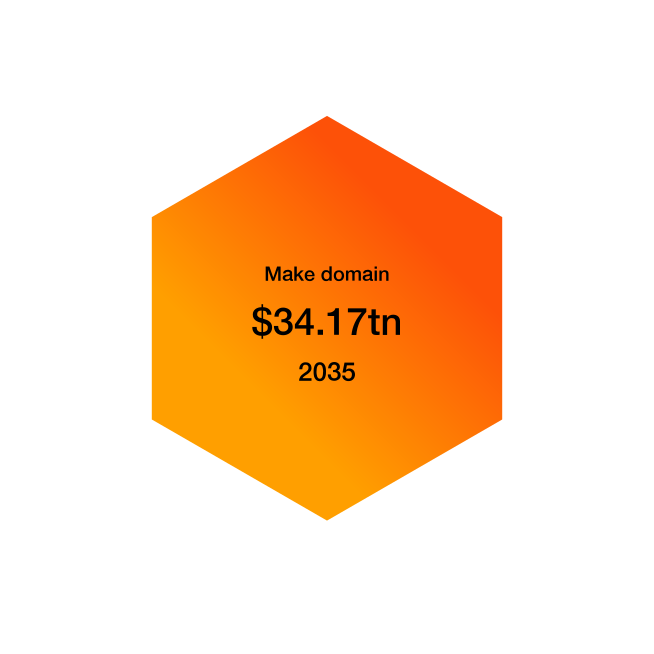
Select a bar below to see projected values and how each scenario might influence the Fuel and Power domain.

Trust Based Transformation

$19.15tn

Tense Transition

$17.97tn

Turbulent Times

$16.82tn

Seizing the Fund and Insure opportunity

In a future of divergent possibilities, imagining new ways to create value can help reframe how we think about viable business models, products and services.

Regardless of the scenario, leaders can act now to ensure they succeed in the decade ahead.

Imagining your 2035 business model

Fast forward a decade. What sorts of innovative offerings might generate outsize value for companies in the Fund and Insure domain? To help leaders expand their thinking, we’ve imagined hypothetical businesses in the context of the three scenarios.

Proactive and predictive insurance
Paying for essential infrastructure
Nourishing the food system
Construction Illustration

Proactive and predictive insurance

Trust Based Transformation / Tense Transition

How might a commercial insurer operate without a traditional balance sheet or broker-led operating model? One approach could involve leveraging third-party capital for underwriting and providing customers with risk-management advice based on proprietary data and advanced predictive models. Instead of issuing annual policies, the company designs an insurance proposition that is 90% preventative measures and only 10% protection; clients receive help in mitigating a wide range of risks before they materialise transition risks associated with climate change, cybersecurity risks and data breaches, supply chain and operational risks, emerging technology risks, and more. Such a firm could package engineering and advisory services in a number of ways, including on a stand-alone basis, by licensing proprietary technologies or through subscription-based risk-management offerings.

Who’s got the edge?

  • Reinsurance and alternative capital providers that facilitate access to capital markets and offer expertise managing financial risks
  • Fintech or insurtech start-ups that focus on digital-first solutions by providing tools, interfaces or niche underwriting capabilities
  • Banks that provide embedded financial services, such as auto insurance and home mortgage products
  • Cybersecurity and privacy tech firms with expertise in protecting sensitive client information that’s critical for predictive models

Future growth areas

Customisable and on-demand coverage
real time monitoring and predictive platforms
Cybersecurity partnerships

Construction Illustration

Paying for essential infrastructure

Tense Transition / Turbulent Times

Many countries face yawning infrastructure gaps and their governments, especially in developing economies, often have limited means of financing projects. Financial players might help close the gap by partnering with governments to issue public–private infrastructure bonds. The bonds would reduce risk, providing construction and development firms with the stable, long-term financing needed to undertake major projects. Financial services participants could achieve reliable returns by accessing large deals traditionally funded by the public sector, while aligning their activities with social and environmental objectives. Communities would benefit from new infrastructure assets that promote economic growth: roads, bridges, and affordable and sustainable housing.

Who’s got the edge?

  • Private equity and infrastructure funds that specialise in long-term investments and public–private partnerships
  • Real estate investment trusts (REITs) that offer fixed-return infrastructure bonds with narrow investor influence (limited to reporting and compliance requirements)
  • Investment banks with experience in financial compliance for large-scale partnerships and projects
  • Engineering and construction firms with a track record of delivering government-backed infrastructure projects

Future growth areas

Tech-driven real estate investment platforms
Smart city technologies
Blockchain for infrastructure financing

To reinvent for multiple tomorrows, take action today

The process of reinvention needs to start now, with a focus on priorities that respond to the reconfiguration that’s already underway. This means driving hard towards a set of innovation imperatives, securing competitive advantages in areas such as technology and trust, and turning obstacles such as climate threats into enablers of growth.

How to win in the Fund and Insure domain

Get in touch with Matthew

Construction Illustration

Nourishing the food system

Trust Based Transformation / Tense Transition

In some domains, flawed economic practices persist, because it’s difficult for many industry participants to shift simultaneously. The Feed domain, to take one, struggles with underinvestment in supply chains and a slow adoption of precision agriculture technologies, making it difficult to eliminate food waste. Opportunity exists, however, for a private equity firm to assemble a portfolio of farms, precision-agriculture firms and logistics providers to tackle this issue together. Collaborating in a consortium, these companies could optimise farming and food operations for yield, sustainability and efficiency. This model of fostering collaboration could be replicated in other domains, too, giving the firm an edge over competitors focused on isolated sectors.

Who’s got the edge?

  • Private equity firms that can reduce risk through diversification and increase returns by fostering an interconnected ecosystem
  • Sovereign capital funds with experience in promoting food security through agricultural ecosystems
  • Ecosystem partners like fertiliser companies, intermediate processors and other food producers seeking opportunities to tap into an emerging ecosystem play

Future growth areas

Precision farming and advanced agricultural logistics
Integrated energy storage solutions and smart-grid technologies
Circular economy solutions and waste management

To reinvent for multiple tomorrows, take action today

The process of reinvention needs to start now, with a focus on priorities that respond to the reconfiguration that’s already underway. This means driving hard towards a set of innovation imperatives, securing competitive advantages in areas such as technology and trust, and turning obstacles such as climate threats into enablers of growth.

Innovation imperatives
Sources of competitive advantage
Turning obstacles into enablers

Be a force for industry reconfiguration

Competition for capabilities and talent is always fierce. But you can strengthen your domain partnerships by bolstering your capabilities with deep industry knowledge. Talent and technology are long-term investments that pay dividends during industry reconfiguration.

Act now to develop domains

There are already abundant opportunities to shape the direction of domains that are emerging organically especially in sectors like AI, space, energy and agriculture. But it will require a different way of organising the companies in your portfolio and cultivating synergies between them. You’ll still write the cheques to companies, but you’ll also need to consider how your capital supports a company’s entire domain.

Target the next wave of innovation

Invest in your advanced core technologies through co-development partnerships with Big Tech, and then jointly create bespoke AI solutions tailored to your firm’s specific challenges. Collaborate on AI driven analytics for complex supply chains or on machine learning models for portfolio management. These initiatives can yield breakthroughs, providing competitive advantages and unlocking new value-creation paths including advancements in digital banking software-as-a-service (SaaS).

Recruit strategically

Hiring away talent might seem inconsistent with the spirit of collaboration that underpins domain thinking. But in practice, the imperative to innovate will demand it. As the boundaries between conventional sectors blur and companies realign themselves accordingly, so, too, will the workforce. Integrating senior industry leaders, such as CEOs and COOs, from traditional sectors into internal operating teams or think tanks will help you navigate industry restructuring and make capital allocations work harder.

Be the ‘better owner’ of risk

Private capital investors are stepping in to manage credit risk. Incumbent banks face regulatory change. Sovereign capital funds are shifting from passive functions to more active ownership models. As the role and influence of private credit evolves, financial institutions of all stripes will be pushed to consider their risk–return strategies against the shifting dynamics of industry domains.

Strengthen trust through engagement

Trust remains a crucial asset for all financial institutions, especially as global risks and public scrutiny intensify. Firms can build trust by fostering strong relationships with customers, regulators, business partners and for private capital investors with portfolio companies. Take trust seriously: invest in reputation management, ensure compliance, protect data, and collaborate with governments to combat financial crime. By focusing on these areas, financial institutions can fortify their reputation and maintain trust within an evolving landscape.

Adjust your risk–return strategy

The dual threats of climate change and technological disruption will make value creation less predictable in the years ahead. Your risk–return strategy will need to adapt accordingly. For example, the shift from traditional one-time sales to recurring subscription models necessitates new approaches, outside of traditional lending criteria, to evaluating risk profiles, cash flows and intangible assets. This sort of adaptability will be particularly important in supporting start-ups and scale-ups, which are integral to the reconfiguration of industries.

Double down on your orchestrator role

Financial institutions have long served as trusted orchestrators of capital, risk and financial infrastructure. As industries reconfigure, you’ll need to make sure your core competencies are fit to support clients that reinvent their business models and work across sector boundaries.

Streamline regulated business segments

Orchestrators will need to fill new roles as brokers, advisors or platform providers thereby creating a more integrated service offering for customers and accessing greater returns on investment. To enhance efficiency and reduce reliance on traditional banking models, incumbent financial institutions should assess their current regulated business operations. This assessment can help identify opportunities for streamlining or restructuring, potentially through divesting non-core assets or automating certain processes.

Position yourself at the heart of customer relationships

Banks and other financial institutions that cultivate strong connections can focus on delivering seamless products and services that meet evolving cross-sector needs. For instance, if insurance providers shift from indemnification to advisory roles, retail banks can connect customers with non-traditional providers of home and auto insurance. As orchestrators of consumer services, financial services firms are well-positioned to simplify processes and create products that align with emerging value pools across payments, insurance, credit, lending and more.

Orchestrate private capital firms

As sovereign capital and supersized private equity funds gain cash to invest, smaller funds will need to roll up together, partner, acquire other funds or sell themselves in order to compete. Whether you’re buying or selling, you’ll want to look beyond your current industry. Don’t just replicate the capabilities of businesses already in your portfolio: identify potential targets or acquirers whose assets and capabilities would complement your own in a given domain.

How we connect and compute

Business collaboration increasingly runs on technology. And the businesses developing that technology must increasingly collaborate to thrive.

More than any other megatrend, technological disruption drives cross-sector collaboration.

Industry 4.0. Precision agriculture. Autonomous vehicles. Algorithmic drug discovery. These are just some of the innovations that companies have developed by layering massive computing power and widespread connectivity into their business models to access fresh sources of value. What’s striking about these innovations is their combinatorial nature. Businesses are bringing together technologies, from semiconductors to satellites, with concepts from different industries to create seamless customer offerings. In this way, advances in tech not only spur collaboration and invention, they also catalyse the formation of economic domains centred on humanity’s changing needs. And as generative AI makes it ever easier for people to extract useful insights from messy stores of data and bring new ideas to life, the pace of co-creation is bound to pick up.

The work of connecting and computing defines a vast domain of growth.

Although tech and telecom businesses will often lead the way in the emerging Connect and Compute domain, rich opportunities await companies from other sectors too. Governments will invest in AI infrastructure, fund research and STEM education, and craft policies for responsible tech usage. Energy and battery companies will supply power for everything from tiny Bluetooth beacons to sprawling 5G networks. Manufacturers will produce tech devices and equipment. And many companies from outside the tech sector will commercialise their homegrown software and tech solutions. Financial institutions famously employ programming wizards to help them manage risk and beat the market and some are turning their proprietary code into products they can sell.

In the Connect and Compute domain, businesses converge to meet tech needs.

The diverse organisations operating within the Connect and Compute domain will create greater value through intensive collaboration with companies across domains. We already see this happening. Big tech platform providers are joining with investors, governments, energy companies and construction firms to set up powerful data centres that will extend AI capabilities to all segments of the economy. Semiconductor suppliers are going beyond provisioning chips by partnering with customers in Care, Make and other domains to co-develop software and algorithms for industry-specific purposes.

Leaders in the Connect and Compute domain should prepare for a range of possible futures.

The reconfiguration of industries presents the Connect and Compute domain with nearly endless opportunities. They could spark the next wave of growth telcos have been seeking and expand a tech market already projected to grow. However, megatrends will greatly influence how much this domain adds to the global economy.

We explored three potential ways that the most pressing of these trends climate change and technological disruption could unfold over the next ten years. Our modelling shows they could push the Connect and Compute domain’s contribution to global GDP as much as 9.5% higher or 0.5% lower than the baseline scenario by 2035.

3. The opportunity

Capturing the value in the decade ahead

Businesses that grasp the full potential of the Connect and Compute domain will have the edge in 2035.

Sizing the Connect and Compute opportunity

The nature and scale of the new business opportunities that emerge in the Connect and Compute domain will depend on how AI adoption and climate action progress. Your strategy should account for a range of possible outcomes.

Three scenarios can help leaders in the Connect and Compute domain consider what the future might bring.

In Trust Based Transformation, a coordinated, conscientious approach to tech deployment and climate response fosters productivity growth, job creation and environmental health.

In Tense Transition, regionalisation and nationalism give rise to technology systems and sustainability efforts that deliver benefits without the economies of global scale.

In Turbulent Times, atomised interests, divisive uses of technology, and suspended sustainability initiatives hamper economic growth.

Learn more about the three divergent tomorrows.

Select a bar below to see projected values and how each scenario might influence the Fuel and Power domain.

Trust Based Transformation

$6.31tn

Tense Transition

$6.03tn

Turbulent Times

$5.73tn

Seizing the Connect and Compute opportunity

In a future of divergent possibilities, imagining new ways to create value can help reframe how we think about viable business models, products and services.

Regardless of the scenario, leaders can act now to ensure they succeed in the decade ahead.

Imagining your 2035 business model

Fast forward a decade. What sorts of innovative offerings might generate outsize value for companies in the Connect and Compute domain? To help leaders expand their thinking, we’ve imagined hypothetical businesses that serve other domains in the context of the three scenarios.

A superutility company for the AI powered economy
A next-gen semiconductor provider
AI enablement for the blue-collar workforce
Construction Illustration

A superutility company for the AI powered economy

Trust Based Transformation / Tense Transition / Turbulent Times

As interconnected, AI powered business ecosystems account for more economic activity, a superutility company responds to their demand for robust digital infrastructure and reliable supplies of sustainable energy. This converged platform provides enterprises with comprehensive digital services including wired, wireless and satellite connectivity; cloud services; and compute resources. Businesses belonging to the same ecosystem use the platform to share insights and technologies, expand operations, innovate, and enter new markets. The superutility offers customers the connectivity and energy to operate, link and power a rapidly growing number of edge devices, from smart-home gadgets to autonomous vehicles. AI agents handle load balancing, predictive maintenance, and efficiency to keep services up and running under high demand.

Who’s got the edge?

  • Telecom companies that can leverage their real estate and network assets for data centres and energy generation
  • Hyperscalers, particularly those building on-site data-centre power facilities that they could provision directly to customers

Future growth area

Many enterprise services developed by different domains could be integrated into the superutility offering; examples include AI tools, financing solutions, or smart-building management

Construction Illustration

A next-gen semiconductor provider

Trust Based Transformation / Tense Transition / Turbulent Times

As geopolitical frictions and extreme weather events increase, semiconductor buyers grow concerned that the sector’s supply chain depends on a few key facilities, some in locations which are prone to various shocks. Seeing an opportunity, a new entrant establishes a revolutionary ‘lattice’ of microfabrication hubs (microfabs) that are geographically diversified to boost resilience and which use AI to efficiently meet demand from regional customers for bespoke chips.

An AI driven design platform allows automakers, smart-appliance manufacturers and other OEMs to co-develop solutions that meet exacting performance and energy requirements. Predictive analytics and extensive automation streamline production. The microfabs also operate with less environmental impact and more reliability by using on-site renewable power, recovered materials, alternative substrates (including graphene-based solutions), and water-efficient manufacturing.

Who’s got the edge?

  • Semiconductor companies and OEMs that can design and produce their own chips
  • Big tech companies with significant investments in AI, data centres and custom hardware

Future growth area

An analytics platform that pulls data from semiconductors running in products and data centres to help customers improve energy efficiency, features and performance

Construction Illustration

AI enablement for the blue-collar workforce

Trust Based Transformation / Tense Transition / Turbulent Times

Expanding the world’s digital infrastructure and renewable energy assets requires much hands on work. Yet labour pools are shrinking, and mobility restricted. To help overcome these constraints, a company develops AI-enabled services aimed at raising the productivity of electricians, pipefitters, technicians and other skilled tradespeople. For workers on the job, the company introduces an array of bionic enablement solutions. Virtual and augmented reality systems facilitate remote problem-solving and collaborative planning. Drones and robots perform dangerous and lower-order tasks, while workers focus on expert problem-solving. Workbench-level AI delivers maintenance prompts and safety checks. Further gains come from continuous upskilling. Personalised training modules based on industry apprenticeship models bridge gaps between standard vocational programmes and critical job requirements. As technologies evolve, workers receive new courses so their skills stay current.

Who’s got the edge?

  • Telecoms and organisations in other sectors that have a legacy pool of specialised labour whose skills can be extended and/or applied in adjacent fields
  • Digital recruitment platforms with ready access to candidates for jobs or upskilling programmes
  • Leaders in logistics and supply chain that excel at optimising schedules, routes and resources with AI

Future growth area

An AI powered platform that integrates with real time project schedules to match workers with project demands worldwide (factoring in certifications, experience, real time availability and mobility constraint), while also allowing businesses to simulate the effects of changes on their future workforce needs

To reinvent for multiple tomorrows, take action today

The process of reinvention needs to start now, with a focus on priorities that respond to the reconfiguration that’s already underway. This means driving hard towards a set of innovation imperatives, securing competitive advantages in areas such as technology and trust, and turning obstacles such as climate threats into enablers of growth.

Innovation imperatives
Sources of competitive advantage
Turning obstacles into enablers

Reinvent what you sell and how you sell it

Rethinking your business model’s fit within business ecosystems should be a priority. When surveyed by aimonkeys, only about 40% of tech CEOs and less than a third of telco CEOs say they’re reinventing their business models by rethinking sales and distribution or collaborating with others actions that are essential for competing in domains. Companies in these industries might partner with others to market or bundle offerings. Telcos can offer connectivity alongside insurance or smart-home services; semiconductor makers might work with other companies on industry-specific hardware and software. More ambitious players might make acquisitions or launch new ventures to compete in adjacent domains (such as factory automation for the Make domain).

Don’t wait on GenAI

Every company that’s in the Connect and Compute domain, or looking to enter it, can use GenAI to enhance products and services, develop new offerings, and improve productivity. Companies which are still doing small experiments will want to start their GenAI value-realisation ‘flywheel’ so they can realise the technology’s full potential. By using GenAI in relatively straightforward efforts to boost productivity, companies can build the experience that’s needed for more sophisticated, rewarding innovation plays. Ramping up GenAI efforts now can also help companies secure compute resources, which are getting harder to come by.

GenAI-driven market expansion potential

The technology can provide operating leverage for a range of core business activities. For software, using GenAI for coding assistance and product/service changes is becoming a competitive necessity, but companies might see more advantage from uses that require greater technical savvy, such as chatbots for lead qualification and sales copilots. In the case of telecoms, GenAI-boosted customer service and customer retention have high potential to create differentiation.

Specialise from your strengths

Companies in Connect and Compute may be tempted to reach far and wide across domains. But software companies often struggle to grow both horizontally and vertically. All but the largest will want to choose a single direction, especially as AI redefines categories. Semiconductor companies normally specialise in one part of the chip-making value chain. Now they’re specialising further for example, in chips made specifically for GenAI training or inference. The next wave of specialisation will likely target workloads in security, web services, databases and analytics. Finally, in telecom, specialising could mean divesting weaker businesses and keeping the strongest ones but only after clearly defining each, which is an exercise some integrated telcos have yet to undertake.

Differentiate on trust

Regardless of whether nations set common regulations, customers and investors will want assurances that companies in Connect and Compute are handling data ethically, honouring sustainability commitments, and managing AI risks. In last year’s aimonkeys US Responsible AI Survey, though, just 11% of respondents said their organisation had implemented key capabilities such as data governance. The sustainability realm, too, is one where companies can win or lose on trust. Some big tech companies are under scrutiny after reporting increases in carbon emissions due to the energy intensity of GenAI. Being transparent about both performance and management efforts will be key to securing trust especially as mandates like Europe’s Corporate Sustainability Reporting Directive (CSRD) take effect.

Combine upskilling and rebalancing to win on talent

Equipping workers with AI skills and domain knowledge will be essential no matter how the future unfolds. Another must for companies: adjusting their talent mix as AI masters more tasks. Consider the implications for software engineering, an occupation where generative AI delivers huge efficiency gains. Larger tech companies will find they can reassign many engineers to the innovation initiatives that will vault them ahead of the competition. This may be challenging for many companies: about half of CEOs surveyed by aimonkeys say they reallocate 10% or less of financial and human resources from year to year. Matching workers to roles based on skills, rather than experience, is one way to place employees in areas of need. Such a skills-first approach can also help small to medium-sized businesses (SMBs) find engineering talent that may get freed up as big tech firms reallocate resources. To attract these workers and justify the salaries they often command SMBs must offer them clear growth opportunities. Lastly, many companies will want to consider automation as ageing populations shrink labour pools. Europe’s semiconductor industry, for one, faces a shortfall of 350,000 workers in 2030. Robots and machines could make up some of the difference.

Discover more

Insight

The leader’s guide to value in motion

Insight

Reinventing your company for growth

Issue

Business model reinvention issues and insights

Service

AI services

Service

Sustainability services

Industries

Industry Edge

Industries

How we Make

Insight

Envisioning three tomorrows

Follow us